About the Kaal Sarp Dosha Check
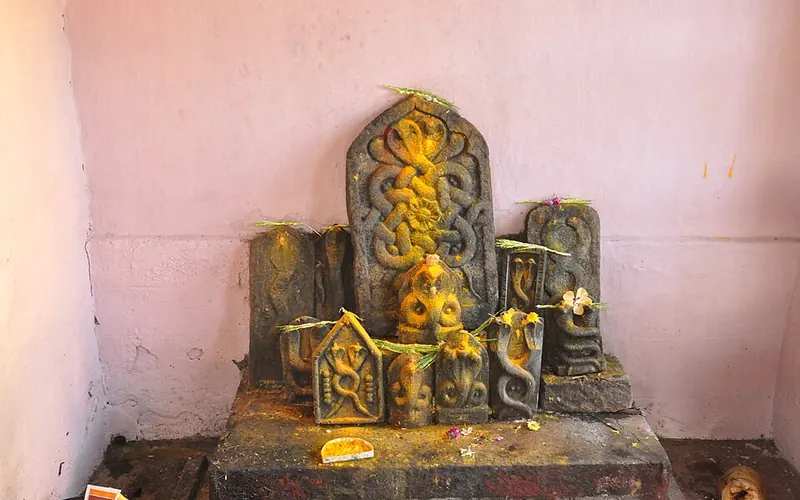
Kaal Sarp yoga (often called Kaal Sarp dosha) is said to form when all seven visible planets, from the Sun to Saturn, sit on one side of the axis between Rahu and Ketu, the Moon's nodes. Rahu is pictured as the head of a serpent and Ketu as its tail, so the image is of every planet held inside the serpent's coil. The yoga is not described in the oldest classical texts such as Brihat Parashara Hora Shastra; it became widely discussed in the last few centuries, and astrologers still debate how much weight to give it.
The tool calculates the sidereal positions of all nine grahas for your birth time and place, measures each planet's distance from Rahu along the zodiac, and checks whether every planet falls within the same half. If all seven do, the result is a full Kaal Sarp yoga. If exactly one planet escapes the axis, many astrologers call it a partial yoga and treat it as much weaker; we show which planet is outside.
The twelve named types depend on the house Rahu occupies from the Lagna: Anant (1st), Kulik (2nd), Vasuki (3rd), Shankhpal (4th), Padma (5th), Mahapadma (6th), Takshak (7th), Karkotak (8th), Shankhachud (9th), Ghatak (10th), Vishdhar (11th) and Sheshnag (12th). Each is linked in popular texts to the themes of the houses Rahu and Ketu occupy, for example the 7th and 1st for Takshak, which is read in the context of partnership.
It is worth keeping perspective. The yoga is common, many successful people have it, and its effects are always read together with the strength of the Lagna, the Moon, Jupiter and the running dasha. Traditional remedies are worship of Shiva, Rahu–Ketu mantras and the Kaal Sarp Dosh Nivaran puja, which our pandits perform online for families abroad, with the sankalp taken in your name and gotra.
How to use this tool
- Enter your birth date, time and place.
- See whether the yoga is full, partial or absent, and Rahu's and Ketu's houses.
- Read the type and, if you wish, book the Kaal Sarp Dosh Nivaran puja.
How we calculate: planetary positions come from the open-source astronomy-engine library (accurate to well under an arc-minute for these purposes), converted to the sidereal zodiac with the Lahiri (Chitrapaksha) ayanamsa. Time zones and historical daylight-saving rules are looked up from your birthplace, so a 1985 birth in Chicago or a 1972 birth in Delhi is converted correctly. Houses are whole-sign from the Lagna, and Rahu/Ketu use the mean node. Results are for self-reflection and education; they are not medical, legal or financial advice.
Frequently asked questions
Is Kaal Sarp dosha in the classical texts?
Not in the oldest classics such as Brihat Parashara Hora Shastra. It appears in later works and in modern practice, which is why opinions on its strength vary.
What is a partial Kaal Sarp yoga?
When six of the seven planets are on one side of the Rahu–Ketu axis and one is outside it. Most astrologers consider it much weaker than the full yoga.
Does Kaal Sarp dosha last for life?
It is a birth-chart placement, but its effects are usually said to be felt most during Rahu or Ketu dashas and to ease after about the age of 42 to 48, depending on tradition.
Do I need the exact birth time?
The planets move slowly, so the yes or no result rarely changes with the time. The named type depends on the Lagna, so it does need an accurate time.
Want a personal reading?
Our Jyotish Acharyas can explain your chart over video in English or Hindi.
Book a consultation